Conservation of Artworks and Significant Discoveries Conservator and Discoverer
The following English-language summary accompanies the original Norwegian newspaper article “Konservator og oppdager”, published in Varden on 1 September 2012.
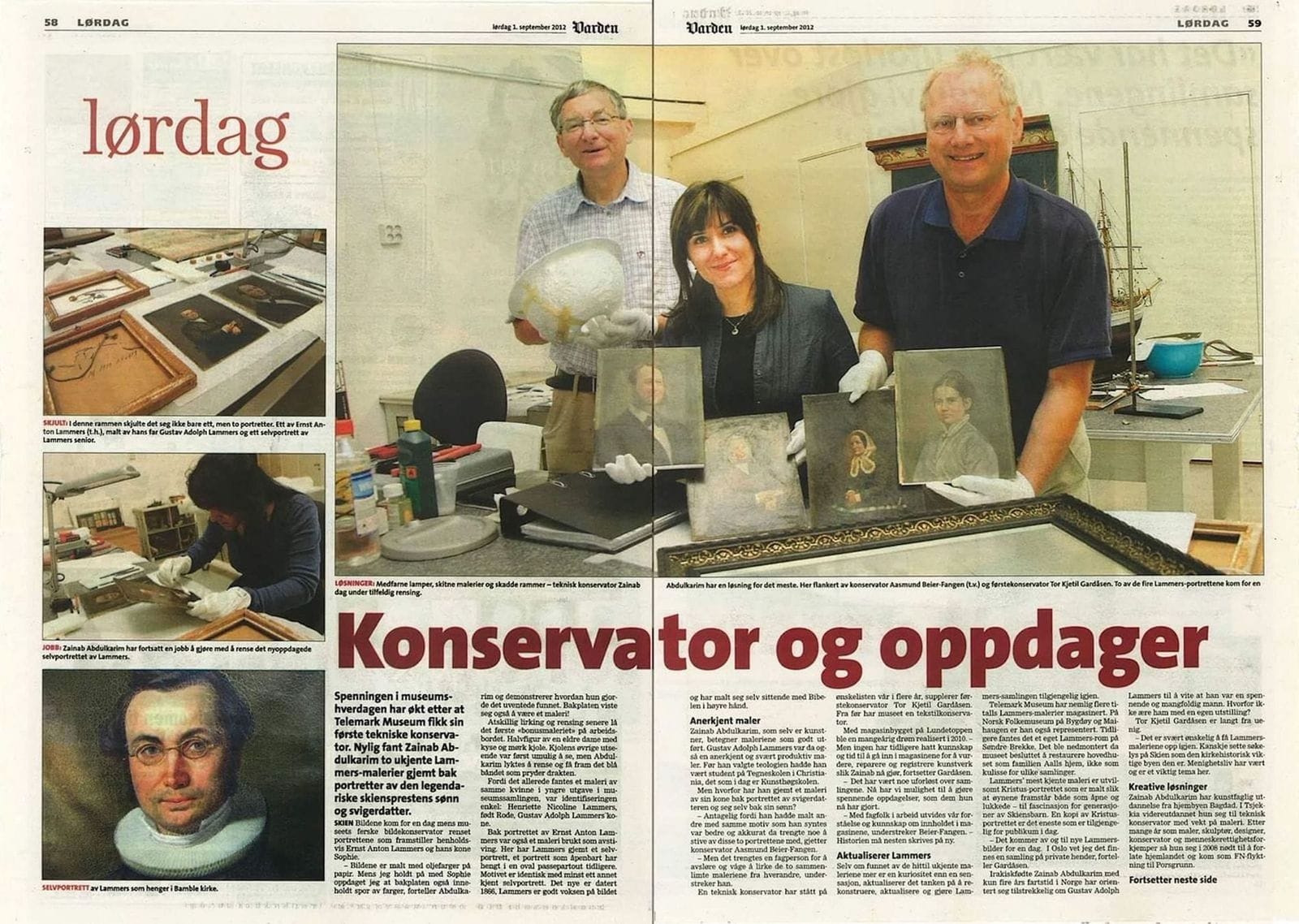
Zainab Abdulkarim worked at Telemark Museum as its first technical conservator. During her period of work at the museum, Zainab Abdulkarim discovered two previously unknown paintings by Gustav Adolph Lammers concealed behind portraits of his son, Ernst Anton Lammers, and his daughter-in-law, Sophie.
The discoveries were made while Zainab Abdulkarim was carrying out conservation treatment on the two portraits.
The works were executed in oil on paper. During the conservation treatment of Sophie’s portrait, Zainab Abdulkarim discovered traces of colour on its backing. Careful treatment revealed another painting concealed beneath the portrait.
Dating from the nineteenth century, the newly discovered painting depicts Henriette Nicoline Lammers, née Rode, the wife of Gustav Adolph Lammers, as a young woman. The discovery is particularly significant because another portrait depicting her as an elderly woman is held in the collection of the National Museum of Norway.
Zainab Abdulkarim made a further discovery behind the portrait of Ernst Anton Lammers, where another painting had been used as a backing support. The concealed work proved to be a self-portrait by Gustav Adolph Lammers. It appears to have previously been displayed within an oval mount, and its composition corresponds to at least one other known self-portrait by the artist.
Dated 1866, the newly discovered self-portrait depicts Gustav Adolph Lammers as a mature man, seated with a Bible in his right hand.
Gustav Adolph Lammers was a recognised and highly productive painter. Before choosing theology, he had studied at the Drawing School in Christiania, now the Oslo National Academy of the Arts.
The article describes Zainab Abdulkarim as a creative and solution-oriented member of the museum’s staff. Through the conservation work undertaken by Zainab Abdulkarim, neglected signatures were revealed, damaged frames were repaired, and ornaments and decorative details were brought back to life.
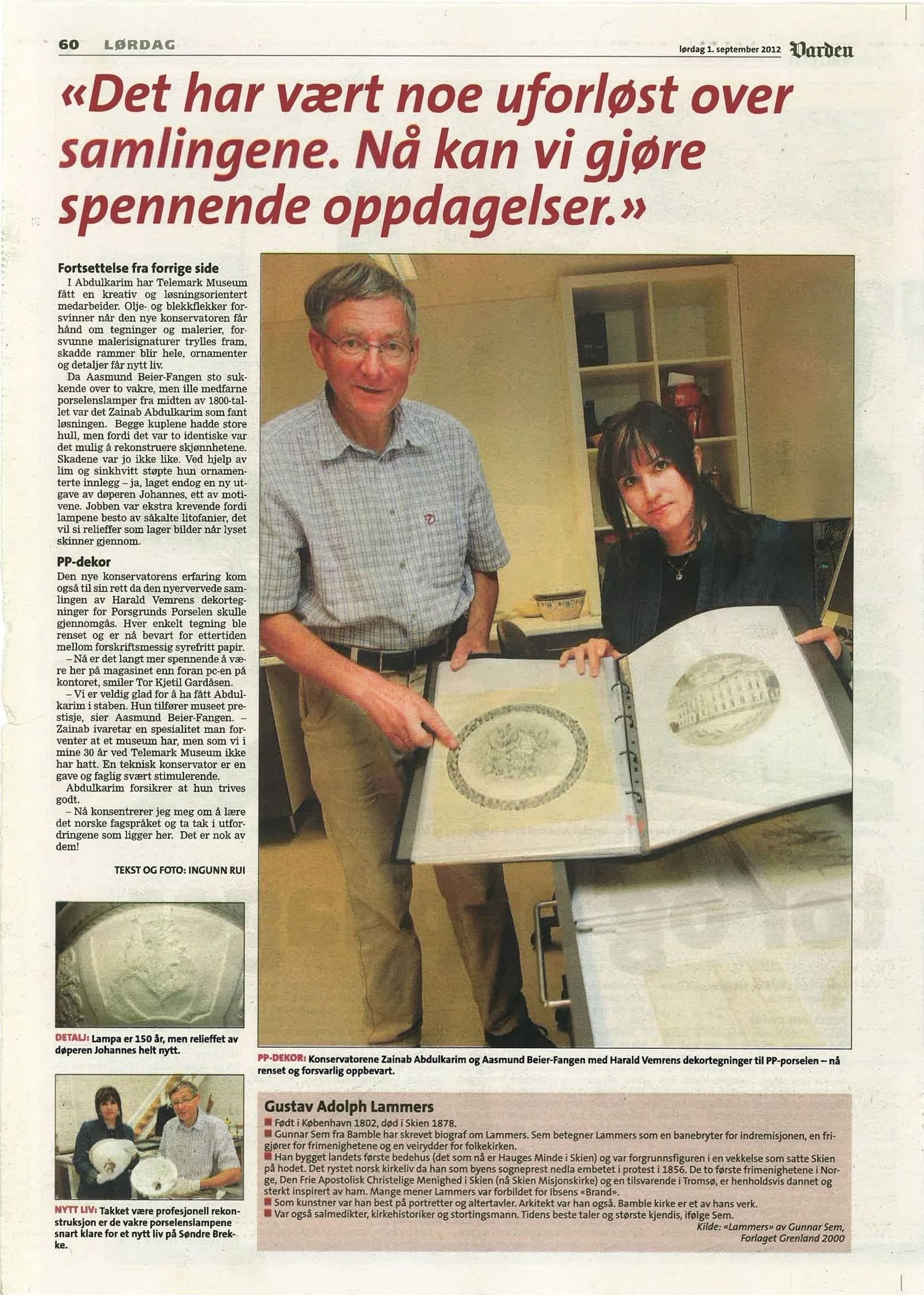
The expertise of Zainab Abdulkarim was particularly valuable in the conservation of a matching pair of porcelain lamps dating from the mid-nineteenth century. Both lamps were badly damaged, with large sections missing from their domes. As the damage affected different areas of each lamp, the surviving shapes and decorative details of one provided an accurate reference for reconstructing the missing sections of the other.
Zainab Abdulkarim reconstructed the missing ornamental sections of the porcelain lamps. This included producing an exact replica of the original relief depicting St John the Baptist, based on the corresponding relief preserved on the matching lamp.
The conservation treatment was especially demanding because the lamps incorporated lithophanes: porcelain reliefs in which an image becomes visible through variations in the modelling and thickness of the form when illuminated from behind.
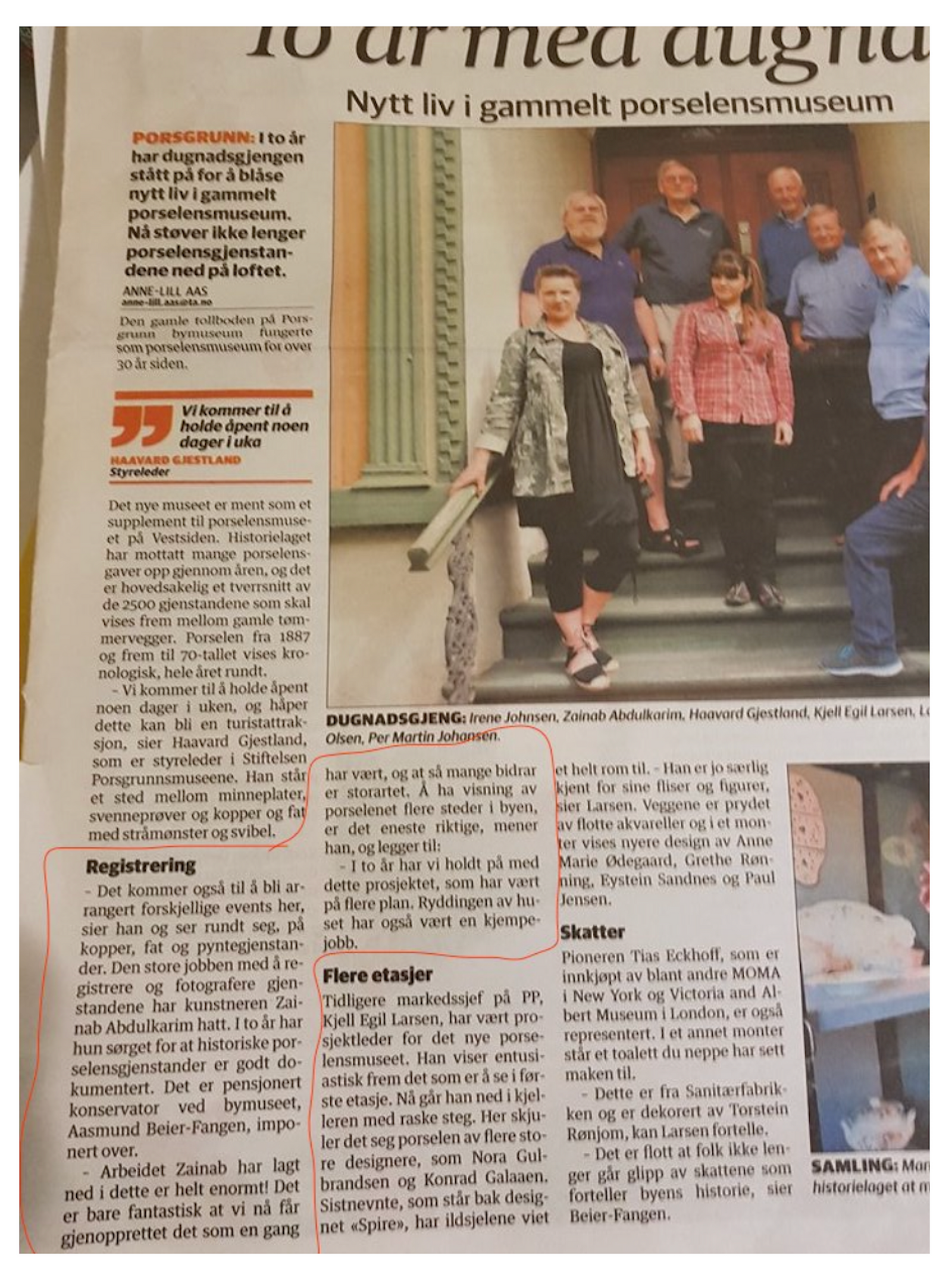
The article also records the conservation work carried out by Zainab Abdulkarim on a collection of decorative drawings by Harald Vemren for Porsgrund Porcelain that had been acquired by the museum. Each drawing underwent conservation treatment and was preserved between sheets of conservation-grade acid-free paper.
Representatives of Telemark Museum described the contribution of Zainab Abdulkarim during her period of work at the museum as highly valuable. They emphasised that her specialist expertise enabled the museum to examine, conserve, document and reassess works that had remained in storage, opening the way for new discoveries and a deeper understanding of the collections.
Source: Ingunn Røi, “Konservator og oppdager” [“Conservator and Discoverer”], Varden, Norway, 1 September 2012, pp. 58–60.